Today I had a Western Tanager at my water source! I don't know if I have ever seen a more beautiful bird! It is rarely seen in this part of Texas and is evidently migrating.
The picture is from Wikipedia Commons. It was only here for about 5 minutes (but maybe I'll see it again today?) and I was too stunned by its beauty to get the camera. No photo can show this bird's incredible electric chartreuse color.
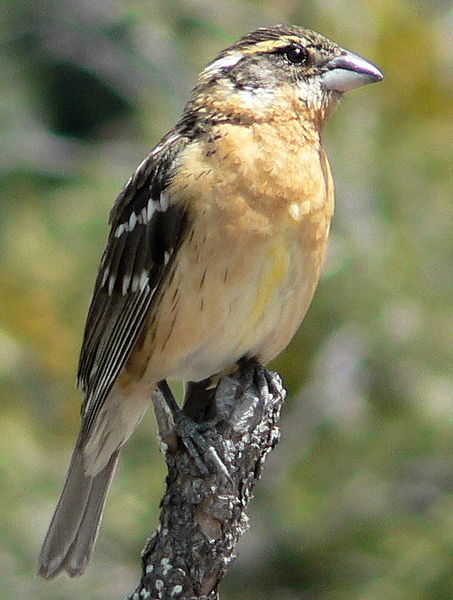
I also had a female Black-headed Grosbeak in my yard eating seed. That's a thrill too. I did get a video of her. Here is a frame freeze.
I feel that I am the luckiest person alive. I live between two locations that have the most colorful and precious birdies. I can't say it is free because I try to feed them all, but it is the least expensive entertainment I can think of and I enjoy it more than any entertainment I could buy at any price. What's better, I have my precious cousin Carol to share my passion with.
Monday, May 23, 2011
Friday, October 1, 2010
Mystery Birds
![]() |
| Loggerhead Shrike (Wikimedia Commons) |
A few Sundays ago, my husband and I got to see a Loggerhead Shrike (top) in our yard several times. It is amazing that he is a full-time Texas resident and I have never seen one before or since. Populations are declining in part of the state due to insecticide use killing off most of the grasshoppers. We had a bumper crop of grasshoppers this year where I live so I don't understand why I didn't see more of them. They also eat other insects, lizards, small mammals, and frogs. We have all of those readily available here in the country north of Stanton, Texas. These birds have to impale their prey on a barbed wire fence or other sharp object because their feet are too weak to hold their catch.
Above is a picture of a European Starling in winter plumage. These birds have been a mystery to me for a few weeks now. I thought they were closer to Starlings than any other bird but I have never seen their winter plumage--only solid black ones. They have a lot of purple and green iridescence in their winter coats. Beautiful! One of the sexes has a lighter-colored head. There are many more pictures here that show this winter oddity.
Labels:
European Starling,
Loggerhead Shrike,
winter plumage
Tuesday, September 7, 2010
Female Blue Grosbeak
My husband and I identified a female Blue Grosbeak a couple of days ago. I had seen her several times before but could not get a good enough look at her to clearly identify her. She has continued to visit our water source and I hope I get to see her husband before they migrate south. They spend the summer here, but I have not seen the male.
They eat mostly insects, but also some seeds and fruit so my feeders offer a little that they might be interested in.
The picture is from Wikimedia Commons.
They eat mostly insects, but also some seeds and fruit so my feeders offer a little that they might be interested in.
The picture is from Wikimedia Commons.
Labels:
Blue Grosbeak
Wednesday, August 25, 2010
Water and Wind!
When I lived in the city, I always provided a bowl of water when I fed the birds. That worked fine. Now that I live in the country, I have discovered that the best way to attract lots of wild birds in the summertime is to have abundant water. At first, I tried offering a basin of water and some did come to it, but not as many as you might think. By accident, I let it run over a few times and it filled ruts in the nearby road. That did it! Birds came from everywhere! I counted nine Bullock's Orioles taking a bath all at one time. Once, I had 5 Pyrrholuxia all at once. They bathe and drink and drink and bathe. Even the Scissor-tailed Flycatchers and Kindbirds and Mockingbirds come frequently to bathe and drink.
The water also attracted a few critters. The park where I live is sort of a sanctuary for wildlife. We have a resident Jack Rabbit that is one of the biggest I have seen. He has come to drink and so have little bunnies and the prettiest (blonde, almost white) spotted ground squirrel I have ever seen came to the water once. Unfortunately, the water also attracts the unwanted--a rattlesnake came to the puddles just outside our fence last Saturday.
We used to see only an occasional quail. When the water is spraying and flowing into the ruts, the whole covey comes to drink--chicks and adults together. We have had coveys of both Bob White and Scaled Quail regularly come to the water.
Night before last, a covey of Scaled Quail came to our yard. I counted 9 or 10 little chicks. Their heads were not fully feathered and they were so cute and fuzzy. They came right up to our steps so I got a good look. They were about the size of the little juvenile male Golden Fronted Woodpecker that comes to my yard daily.
Another thing I have discovered is that, when the wind blows, the birds that mostly fly to get where they are going don't move around much. The doves, the hummer, the House Sparrows and a few Finches will brave it but the colorful birds pretty much limit their moving around during the windiest times.
(photos from Wikimedia)
The water also attracted a few critters. The park where I live is sort of a sanctuary for wildlife. We have a resident Jack Rabbit that is one of the biggest I have seen. He has come to drink and so have little bunnies and the prettiest (blonde, almost white) spotted ground squirrel I have ever seen came to the water once. Unfortunately, the water also attracts the unwanted--a rattlesnake came to the puddles just outside our fence last Saturday.
We used to see only an occasional quail. When the water is spraying and flowing into the ruts, the whole covey comes to drink--chicks and adults together. We have had coveys of both Bob White and Scaled Quail regularly come to the water.
Night before last, a covey of Scaled Quail came to our yard. I counted 9 or 10 little chicks. Their heads were not fully feathered and they were so cute and fuzzy. They came right up to our steps so I got a good look. They were about the size of the little juvenile male Golden Fronted Woodpecker that comes to my yard daily.
Another thing I have discovered is that, when the wind blows, the birds that mostly fly to get where they are going don't move around much. The doves, the hummer, the House Sparrows and a few Finches will brave it but the colorful birds pretty much limit their moving around during the windiest times.
(photos from Wikimedia)
Labels:
bathing,
bobwhite quail,
Bullock's Oriole,
water
Monday, August 9, 2010
Swainson's Hawks Here Today!
This picture of a Swainson's Hawk is from FlickR (Wikimedia Commons) and, judging from its size relationship to the fence post it is standing on, it seems less than half as big as the pair that came to my yard today.
About 7 to 10 days ago, one of these birds landed just outside the chain link fence in my yard. I was so flabbergasted at its size that I could not remain calm enough to start making a positive I.D. One of my dogs started raising such a ruckus that the bird immediately flew. Because it was so large, I thought it might even be an eagle.
Just now, a pair of these birds landed in the dirt road just past my fence. I am still overwhelmed at their size. My books say that the female, which is larger than the male, is 20 to 22 inches long, but I thought she looked bigger than that. These are definitely the largest birds that take flight that I have ever met in person. They may look especially large because their legs are long so they stand tall. The wingspan is 4-1/4 feet.
Because I offer large puddles of fresh water (and a basin too, but they prefer the mud puddles), I always have a lot of birds here. There were Mockingbirds, Scissor-tailed Flycatchers, White Wing Doves, Eurasian Collared Doves, House Sparrows, Grackles, Finches, Bullock's Orioles, Lark Sparrows, Western Kingbirds, and a Curve-Billed Thrasher all jockeying for places in the water just before the two hawks landed.
I didn't see one of them catch it, but there was definitely a small bird in its talons and it began eating it while still in my yard.
Below are two more views (Wikimedia, Megan McCarty) but they do not show how huge these birds are. (I started worrying about my little Shih Tzu, who was outside under the porch.) Swainson's Hawks eat rodents, snakes, small birds, and insects.
I could hear the call they made and it was a familiar sound that I had heard in Western movies a number of times over the years, a very distant-sounding "Keeeaar."

I hate that one of my regulars had to be breakfast, but the hawks have to survive too. I never know if my feeding and making water available makes an unlevel playing field, but I do know that with our 100- to 104-degree temps, some would heat stroke and die without the water.
About 7 to 10 days ago, one of these birds landed just outside the chain link fence in my yard. I was so flabbergasted at its size that I could not remain calm enough to start making a positive I.D. One of my dogs started raising such a ruckus that the bird immediately flew. Because it was so large, I thought it might even be an eagle.
Just now, a pair of these birds landed in the dirt road just past my fence. I am still overwhelmed at their size. My books say that the female, which is larger than the male, is 20 to 22 inches long, but I thought she looked bigger than that. These are definitely the largest birds that take flight that I have ever met in person. They may look especially large because their legs are long so they stand tall. The wingspan is 4-1/4 feet.
Because I offer large puddles of fresh water (and a basin too, but they prefer the mud puddles), I always have a lot of birds here. There were Mockingbirds, Scissor-tailed Flycatchers, White Wing Doves, Eurasian Collared Doves, House Sparrows, Grackles, Finches, Bullock's Orioles, Lark Sparrows, Western Kingbirds, and a Curve-Billed Thrasher all jockeying for places in the water just before the two hawks landed.
I didn't see one of them catch it, but there was definitely a small bird in its talons and it began eating it while still in my yard.
Below are two more views (Wikimedia, Megan McCarty) but they do not show how huge these birds are. (I started worrying about my little Shih Tzu, who was outside under the porch.) Swainson's Hawks eat rodents, snakes, small birds, and insects.
I could hear the call they made and it was a familiar sound that I had heard in Western movies a number of times over the years, a very distant-sounding "Keeeaar."

I hate that one of my regulars had to be breakfast, but the hawks have to survive too. I never know if my feeding and making water available makes an unlevel playing field, but I do know that with our 100- to 104-degree temps, some would heat stroke and die without the water.
Thursday, July 29, 2010
Lark Buntings Return?
We had flocks of Lark Buntings and they were one of the most frequent visitors to my feed sources until the weather warmed up. During the summer, they completely disappeared until today. I just saw a male in our yard.
I couldn't find a good picture. The male is mostly black with white wing patches and a large blue-gray bill. The female is brown with a heavily streaked chest. She has a very mottled appearance (as do some of the males).
A Lark Bunting today, a Western Meadowlark yesterday. Something is changing the makeup of my bird population again. Anyway, I am thrilled to have these two birds starting to come back so I can enjoy them.
I couldn't find a good picture. The male is mostly black with white wing patches and a large blue-gray bill. The female is brown with a heavily streaked chest. She has a very mottled appearance (as do some of the males).
A Lark Bunting today, a Western Meadowlark yesterday. Something is changing the makeup of my bird population again. Anyway, I am thrilled to have these two birds starting to come back so I can enjoy them.
Labels:
Lark Bunting,
western meadowlark
Wednesday, July 28, 2010
Birds Showering Here This Morning
It is cloudy and a little cooler here this morning than it has been. I have the water hose running and there is a fine mist plus some puddles around. The favorite is a tire track that is a few inches deep. It is full of water and has been like a magnet this morning for the thirsty birdies!
I was amazed to see the first Rufous Crowned Sparrow I have seen out here in the Permian Basin Desert. As always the picture (wikimedia.com) doesn't do it justice. That little rusty-colored cap is quite vivid and it is very easy to tell it is not a House Sparrow.
By chance, I looked up to see a Meadowlark fledgling this morning. The Western Meadowlarks are plentiful where I live during cold weather but, though my bird books say they don't migrate, they all disappeared when warm weather came. Glad to see one again. They are so beautiful.
My regulars, also showing up this morning for a drink, include my Canyon Towhee, Cactus Wren, White-winged Doves, Eurasian Ring-necked Doves, House Sparrows, House Finches, Lark Sparrows, Brown Headed Cowbirds, Curve Bill Thrashers, Scissor-Tailed Flycatchers, Western Kingbirds, and Bullock's Orioles.
I love my life here in the country watching these beautiful birds!
I was amazed to see the first Rufous Crowned Sparrow I have seen out here in the Permian Basin Desert. As always the picture (wikimedia.com) doesn't do it justice. That little rusty-colored cap is quite vivid and it is very easy to tell it is not a House Sparrow.
By chance, I looked up to see a Meadowlark fledgling this morning. The Western Meadowlarks are plentiful where I live during cold weather but, though my bird books say they don't migrate, they all disappeared when warm weather came. Glad to see one again. They are so beautiful.
The chance for a bath has appealed the most to a male Pyrrholuxia who has been in the water here repeatedly today. He makes the most noise and splashes more when he is bathing than any of the others. He obviously enjoys it!
I love my life here in the country watching these beautiful birds!
Monday, June 14, 2010
Lark Sparrow
I have seen a Lark Sparrow at a distance several times, but one came to my yard for a few-minutes stay this morning. (Photo is courtesy of www.wikimediacommons.org credit: www.naturespicsonline.com). The beautiful (quail-like) markings on its head, and its slightly bigger size, distinguish it from the House Sparrows here.
Lark Sparrows breed in Texas in the summertime. I have a variety of food and there is water. I didn't see this bird eat anything but I don't know how long it was here before I saw it. It eats seeds and insects. I hope it will visit again.
Friday, June 11, 2010
A Rescued Baby Barn Owl
The best place for any baby bird is with its parents. Chances of survival go down drastically when people have to intervene...and sometimes it is done unnecessarily. This is the time of year when baby birds are on the ground. They are supposed to be. They learn to fly and to feed from the ground. If they have their feathers and are not injured and they try to flutter away, they probably don't need help and their parents are probably nearby.
This little guy was not so lucky. The wonderful people here at the camp where I live found this beautiful baby and it seemed to be orphaned. A dead adult had been found a few days ago. After waiting and watching, it was determined that he was indeed not receiving care and attention from an adult owl.
I called Bebe McCasland in Big Spring. She came with her bullet-proof gloves and secured the owl so that it could be taken to safety. I think it had been 24 hours or so without food.
Thank goodness for licensed wildlife experts. This baby is now at the South Plains Wildlife Rehab Center in Lubbock, Texas. He will live there and learn the way of the owls from his surrogate parents until he can be released into the wild.
This little guy was not so lucky. The wonderful people here at the camp where I live found this beautiful baby and it seemed to be orphaned. A dead adult had been found a few days ago. After waiting and watching, it was determined that he was indeed not receiving care and attention from an adult owl.
I called Bebe McCasland in Big Spring. She came with her bullet-proof gloves and secured the owl so that it could be taken to safety. I think it had been 24 hours or so without food.
Thank goodness for licensed wildlife experts. This baby is now at the South Plains Wildlife Rehab Center in Lubbock, Texas. He will live there and learn the way of the owls from his surrogate parents until he can be released into the wild.
Labels:
barn owl,
Lubbock,
South Plains Wildlife Rehab Center,
TX
Friday, May 28, 2010
Scaled Quail
Two of these gorgeous Scaled Quails came near our yard this evening. We had seen one on the other side of the park where we live about a month ago. They are sometimes called "Cottontops" because of their little white topknots. Their numbers are decreasing due to habitat destruction. They are more common in the dry, desert areas such as the Permian Basin than the Bobwhite Quail.
Labels:
bobwhite quail,
cottontops,
Permian Basiin,
scaled quail
Tuesday, May 25, 2010
Bewick's Wren

The picture above is a Bewick's Wren. One came to our yard last night. It is a precious, interesting, cute, and very tiny bird (5-1/2 inches). It looks a little like a miniature Cactus Wren. The photo is from Wikimedia Commons. I looked for a photo that shows the bird with its mouth open because that is what I saw. It never shut up and it flicked its tail in a prissy manner the whole time it was here. This little bird is here in the Permian Basin year-round. Since insects make up 97% of its diet, and seeds only about 3%, I may not see it often at my feeder.
The picture on the left is a Great Crested Flycatcher. It has been to the yard several times briefly and I had not been able to identify it until now. In retrospect, I believe I have seen this bird in the trees several times and mistook it for a Western Kingbird because of the yellow belly. It is about 9 inches in length and has a very proud, regal appearance. It breeds here in the summer. It eats insects and fruit. I didn't see it feed while it was here, but it has come into the yard on three different days so something is attracting it.
Labels:
bewick's wren,
cactus wren,
great crested flycatcher
Saturday, May 15, 2010
Saturday Morning Red Eye!
The Bronzed Cowbird is distinguishable from the Brown-headed Cowbird by his red eye and prominent neck ruff. He also has very bluish-green wings and is a pleasure to see. He has been feeding in the yard off and on this morning.
The yard is full of birds this morning after our rain, hail, and tornado watches yesterday and last night. A number of fledglings are begging to be fed, though they seem to be pretty good at eating independently when they have to.
Labels:
Bronzed cowbird,
fledglings
Wednesday, May 12, 2010
Canyon Towhee
I have been trying to identify this bird for about a week now. At first I thought it was a Say's Phoebe. It is about that size and overall color but it differs in that it has a rusty cap and undertail. It also has a necklace of dark spots on its chest.
It lives in the Permian Basin all year long and may mate for life. I believe I have seen a female too but need another look to be sure.
A male and two female Bullock's Orioles were in the yard this morning. Such an electric orange!
It lives in the Permian Basin all year long and may mate for life. I believe I have seen a female too but need another look to be sure.
A male and two female Bullock's Orioles were in the yard this morning. Such an electric orange!
Sunday, May 9, 2010
Another Viewing Day with Cousin Carol
Cousin Carol came over Friday, May 7, and we sat in our perfect viewing spot and watched the kaleidoscope of birds for about 5-1/2 hours or so.We saw: male and female Lark Buntings, White-Crowned Sparrows, Eurasian Collared Doves, Say's Phoebe, White-Winged Doves, female Brown-headed Cowbird, male and female House Finch, European Starlings, male and female Golden-Fronted Woodpeckers, Scissor-tailed Flycatchers, Western Kingbirds, Cactus Wren, and a hawk of some kind.
Carol identified two additional birds: A yellow male House Finch (diet causes the variant) and a female Black-headed Grosbeak (top). They are evidently migrating through here on the way to Mexico/South America.The male was here for about five days but didn't show up on Friday. The males show up here in the spring before the females.
Tom and I had a visit from a female and three young Yellow-Headed Blackbirds yesterday (right). They were in the Mesquite tree early this morning but did not come into the yard to feed with the other birds. They stay in Texas for the summer, but maybe they are migrating to a different locale in Texas because we only saw the males for one day and have not seen them again.
Wednesday, May 5, 2010
Red-Winged Blackbird
I put up a thistle sock a week or so ago, thinking the House Finches would enjoy it. Just now, a Red-winged Blackbird was feeding on it. The Woodpeckers, Orioles, and Grosbeaks, both male and female, come frequently to the feeders.
I just looked up to see a beautiful little bird, maybe a Finch of some sort, kind of chartreuse colored. I haven't identified it yet.
Tuesday, May 4, 2010
My beautiful Orioles, Woodpecker, and Grosbeaks
The Bullock's Oriole has frequented the apple I put in the yard for the birds. Yesterday a female (see picture) appeared and she has been back this morning. She is not quite as pale as the picture shows.
There were two Black-headed Grosbeaks here at the same time this morning. They have taken up residence in the Mesquite tree just outside the fenced part of my yard. It looks like they plan to stay, at least a while. They have come to the feeders frequently during the day since they first showed up.
All of the birds love the apples I am putting out (except for the doves). The Golden-Fronted Woodpecker comes at least once or twice daily.
There were two Black-headed Grosbeaks here at the same time this morning. They have taken up residence in the Mesquite tree just outside the fenced part of my yard. It looks like they plan to stay, at least a while. They have come to the feeders frequently during the day since they first showed up.
All of the birds love the apples I am putting out (except for the doves). The Golden-Fronted Woodpecker comes at least once or twice daily.
Sunday, May 2, 2010
Bullock's Oriole
This beauty came to the yard this morning. At first I thought it was another Grosbeak, but it has more vivid orange coloring and a more definite white stripe on the wing. The Bullock's Oriole also has orange above the eye and a black stripe through the eye.
The Bullock's Oriole breeds here during the summer. It enjoyed a bite or two of the apple we put out before it flew away. The Black-Headed Grosbeak and the Golden-Fronted Woodpecker have both been here this morning, several times.
Saturday, May 1, 2010
Black-Headed Grosbeak
I can't find a good picture that I can show. You can follow the link to Allaboutbirds.org to see this beauty. He is much more vivid than the picture shows. His orange is very bright and his black is very dark.
He has spent the day in our yard, eating seed and sharing an apple with our Golden-Fronted Woodpecker. He spends his winter south of us and is headed north for the breeding season. Thrilled to have him!
Friday, April 30, 2010
Birdwatching Day with Carol


Yesterday my cousin, Carol, came around 10 a.m. Since we both love birds, we planned a day of just sitting in front of the sliding glass double-door of my RV and birdwatching. I feed the birds just outside it and we have a very clear view of them when they come in the yard.
Here are some of the birds we saw: House Finch, House Sparrow, White-Crowned Sparrow, White-Winged Junco, Scissor-Tailed Flycather, Curved-Bill Thrasher, Say's Phoebe, a sparrow I have not identified, European Starlings, Cactus Wren, Grackles, Hummingbird, and probably others I am forgetting.
This picture (bottom row) does not do justice to the Scissor-Tailed Flycathcer. The breast area of the two that visited us was a beautiful apricot color.
We also saw a couple of Horned Toads (second row). These prehistoric guys used to be so plentiful in Texas when we were kids and are drastically decreased in number now.
The most exciting thing we saw was two Curved-Bill Thrashers chasing a snake. The snake was moving at lightning speed. I think he knew the two Thrashers did not have friendly intentions. Anyway, he outran them.
We wished that our Aunt Patsy could have been here to watch with us. We sipped white tea during the morning and had a big salad full of all kinds of yummy veggies. It was a wonderful day.
I got a chance to go walking this morning and saw a lot of Barn Swallows (picture above is third row). Carol and I caught a glimpse of a few yesterday that flew near the yard here.
This morning, a Tufted Titmouse (top row) came to visit for about 15 to 20 seconds. I hoped it would hop down and join the other birds, but it decided not to. I thought I caught a glimpse of it yesterday while Carol was here, but I am not sure. Anyway, the picture doesn't do him justice. His colors are prettier than the picture.
Saturday, April 24, 2010
Subscribe to:
Posts (Atom)